
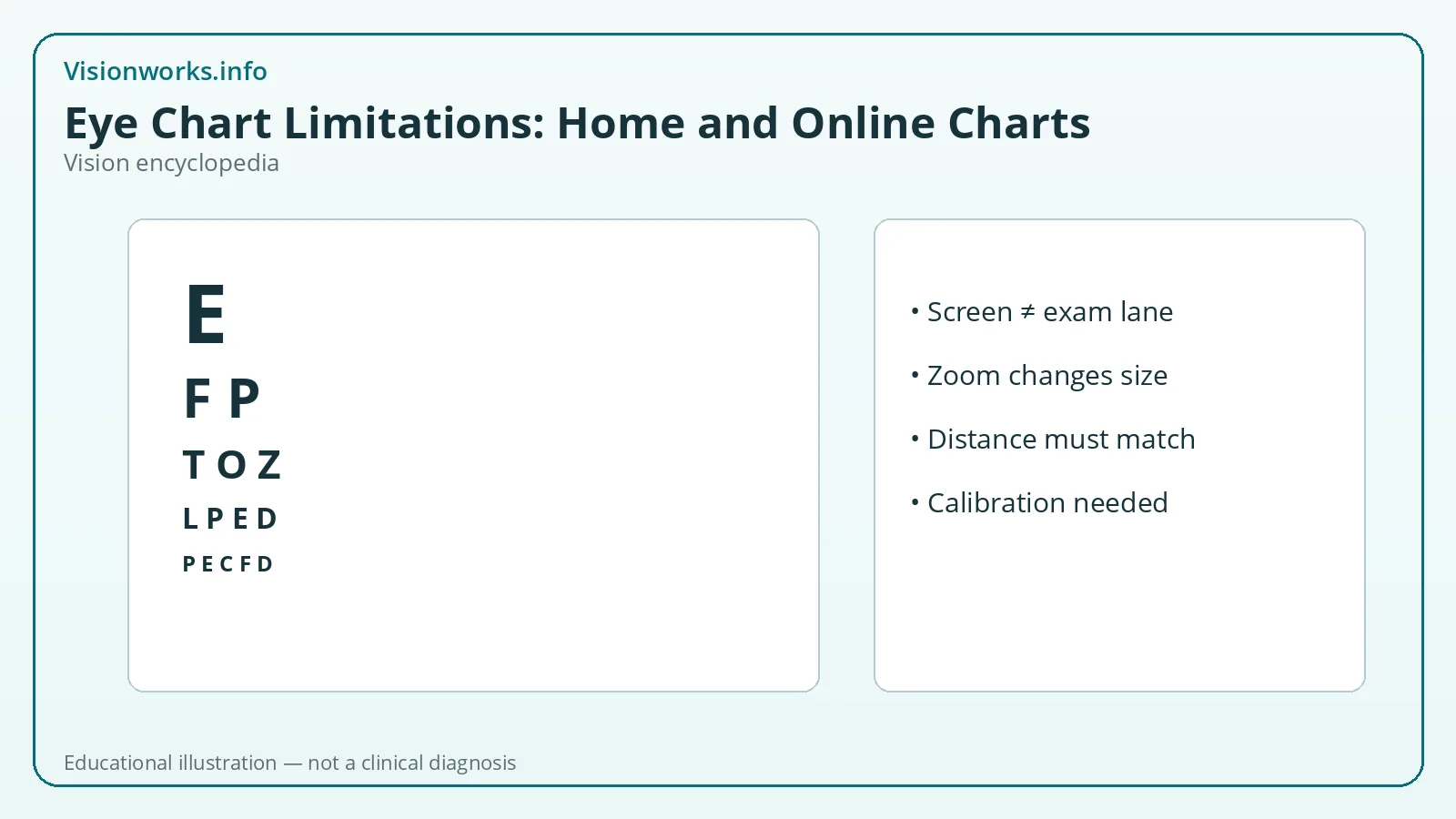
The core problem: angular size
Clinical optotypes are sized so that details subtend specific angles at a stated distance. If letter height is wrong or distance is wrong, the labeled “20/20” line is misnamed.
On computers and phones, layout engines size shapes in CSS pixels. CSS pixels are not physical millimeters until the device pixel ratio, OS scaling, and display PPI are accounted for — and even then, browser zoom breaks the chain. CSS pixels alone are not calibrated optotype angular size.
That is why Visionworks.info labels its visual acuity tool as educational and discusses calibration limits rather than promising clinic-equivalent scores.
Distance, posture, and “almost 10 feet”
Many DIY instructions say “stand 10 feet away” without measuring. A foot or two of error changes angular size enough to shift line difficulty. Leaning toward a laptop after missing a letter is another common bias.
Phone testing at arm’s length is especially fragile: small absolute errors in distance are large percentage errors. Rooms that are too short encourage improper scaling shortcuts.
Clinic lanes are measured. Home hallways usually are not.
Lighting, contrast, glare, and fatigue
Bright windows behind a monitor wash out contrast. Night mode tints reduce fidelity. Dry eyes after long screen sessions temporarily degrade performance. None of those factors are “cheating,” but they make home-to-clinic comparisons unfair.
Children may fatigue quickly or peek around occluders. Adults may memorize charts shared on social media. Validity dies quietly in these details.
What online charts cannot see
Even a perfectly calibrated acuity estimate would still miss intraocular pressure trends, retinal disease, optic nerve change, and many binocular disorders. Acuity is one test among many in a comprehensive exam.
AAO and AOA education both place chart testing inside a larger exam structure. Using a browser chart to postpone care after unilateral vision loss is a category error.
Contact lens and glasses prescriptions require clinical refraction and professional judgment — not a screenshot of the smallest letters you think you saw.
How to use our educational tool wisely
Open the visual acuity test to explore how letter size relates to notation. Keep browser zoom at 100%, follow on-page distance guidance, and read the limitations section on the tool page.
If one eye seems dramatically worse than the other, or acuity feels suddenly reduced, schedule a professional exam instead of buying stronger OTC readers or repeating apps.
Pair chart learning with encyclopedia pages on Snellen notation and exam expectations so vocabulary is clear when you speak with a clinician.
Deeper context for careful readers
This page (/vision/eye-chart-limitations) is written for education, not diagnosis. The goal is to help you ask better questions at a real appointment and to understand vocabulary you may see on charts, portals, or prescription printouts.
Authoritative organizations such as the AOA, AAO, NEI, and MedlinePlus publish consumer-facing explanations that clinicians still individualize. If anything you read here conflicts with advice from your eye doctor, follow your clinician — they can see your eyes and history; a website cannot.
Between visits, note changes by eye, by distance (far versus near), and by timing (constant versus end of day). Those details make exams more efficient without turning self-tracking into self-diagnosis.
Urgent warning signs still override any routine schedule: sudden vision loss, a curtain or shadow, painful red eye with nausea, chemical exposure, or trauma require prompt in-person care.
Visionworks.info tools can reinforce concepts — acuity notation, prescription fields, symptom vocabulary — while remaining explicitly non-diagnostic. Use them as study aids alongside professional care, not as replacements for refraction, dilation, or medical treatment decisions.
When you compare information across websites, prefer primary sources from AOA, AAO, NEI, MedlinePlus, CDC, FTC, or FDA pages that match your topic. Marketing blogs and unverified social videos often oversimplify intervals, prescriptions, or “pass/fail” chart claims.
Finally, keep expectations proportionate: understanding a term should make your next visit clearer, not turn you into your own optometrist. Curiosity is useful; unsupervised lens ordering from guessed numbers is not.
When professional care matters
Schedule an eye exam if you notice new blur, eye discomfort that persists, headaches tied to visual tasks, difficulty with night driving, or any sudden change in vision. Children, people with diabetes, and anyone with a history of eye disease often need scheduled professional monitoring rather than relying on online tools alone.
Seek urgent or emergency care for sudden vision loss, a curtain or shadow over vision, new flashes with many floaters, severe eye pain, chemical exposure, or eye trauma.