
The role of acuity in the exam
Visual acuity testing asks a focused question: how well can each eye resolve high-contrast detail at a specified distance? It is usually among the first measurements in an eye exam because it anchors later decisions about refraction and urgency.
AAO exam education describes reading an eye chart to determine how well you see at various distances and whether vision reaches a 20/20 level under the test conditions. AOA materials likewise list visual acuity measurement as a core element of comprehensive exams.
Acuity is necessary but not sufficient. Healthy-appearing acuity can coexist with early glaucoma, diabetic retinopathy, or peripheral retinal issues. Low acuity can be refractive, medical, or both.
How the clinical test is run
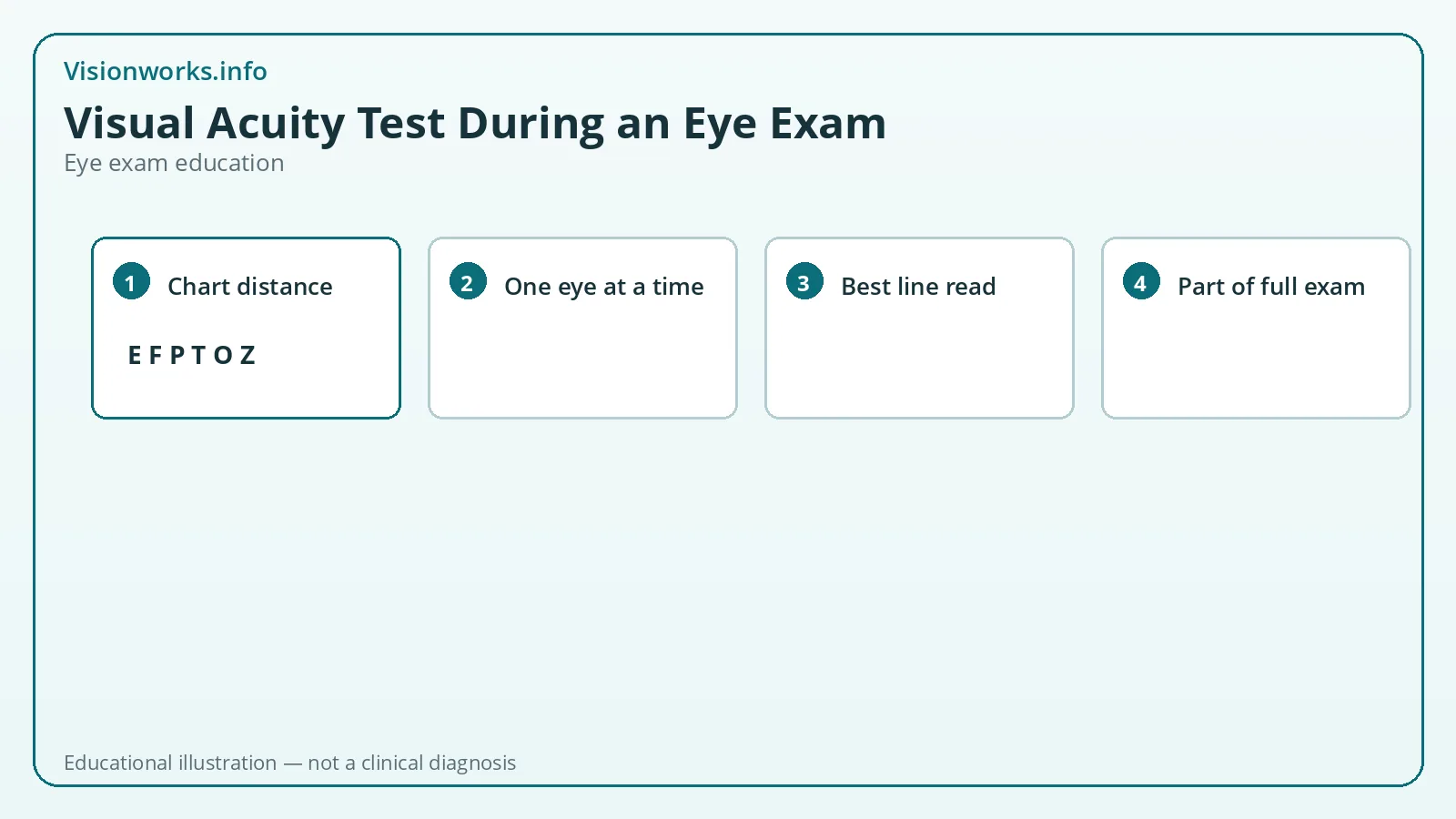
You typically stand or sit at a calibrated distance from a printed, projected, or electronic chart. One eye is occluded while the other reads progressively smaller lines. Clinicians note the smallest line read with defined accuracy criteria. Near acuity uses a calibrated near card at a stated working distance.
Lighting, contrast, chart design (Snellen, ETDRS-style, Lea symbols, tumbling E), and whether you wear habitual correction all influence results. That is why comparing a tired late-night phone screenshot to a clinic score is misleading.
Pinhole acuity is sometimes added. Viewing through a pinhole can reduce the effect of uncorrected refractive error. If pinhole improves vision substantially, refractive blur is a likely contributor; if it does not, other causes deserve attention. This is a clinical clue, not a home diagnosis method.
Notations you will see
Snellen fractions such as 20/20 or 20/80 are common in the United States. Metric 6/6 style notations, decimal acuity, and logMAR scores appear in research and some clinics. Our acuity library and Snellen converter explain how these relate educationally.
“Best corrected visual acuity” (BCVA) refers to acuity with the best refractive correction in place. Habitual acuity with your current glasses may be worse if the prescription is outdated. Both numbers can be clinically useful.
Legal or occupational vision standards (for example, some driving license requirements) use acuity thresholds, but those rules are jurisdiction-specific and separate from whether your eyes are healthy. This site does not provide state DMV legal advice.
Children, symbols, and special charts
Young children may use pictures, LEA symbols, or matching games rather than adult letters. Preferential looking techniques exist for infants in specialty settings. Using an adult letter chart app on a toddler is not a valid substitute for pediatric assessment.
Low-vision evaluations may use specialized charts, lighting, and magnifier assessments. Standard 20-foot narratives do not capture functional vision for everyone.
If a child fails a school screening, the next step is a comprehensive exam — not repeated guessing on a hallway chart. Screening is a filter; diagnosis and management need a clinician.
Clinic charts vs educational online charts
Clinical acuity depends on optotype angular size at a known distance. On phones and laptops, CSS pixels, device pixel ratio, browser zoom, and seating distance all change the true letter size. Without physical calibration, an on-screen “20/20” line is not a clinical claim.
Visionworks.info offers an educational visual acuity tool so you can learn how letter size relates to notation. It is intentionally not marketed as a diagnostic instrument. Read our eye-chart limitations article before drawing conclusions.
If clinic acuity drops unexpectedly — especially in one eye — seek professional evaluation promptly rather than re-testing on multiple apps.
Deeper context for careful readers
This page (/eye-exams/visual-acuity-test) is written for education, not diagnosis. The goal is to help you ask better questions at a real appointment and to understand vocabulary you may see on charts, portals, or prescription printouts.
Authoritative organizations such as the AOA, AAO, NEI, and MedlinePlus publish consumer-facing explanations that clinicians still individualize. If anything you read here conflicts with advice from your eye doctor, follow your clinician — they can see your eyes and history; a website cannot.
Between visits, note changes by eye, by distance (far versus near), and by timing (constant versus end of day). Those details make exams more efficient without turning self-tracking into self-diagnosis.
Urgent warning signs still override any routine schedule: sudden vision loss, a curtain or shadow, painful red eye with nausea, chemical exposure, or trauma require prompt in-person care.
Visionworks.info tools can reinforce concepts — acuity notation, prescription fields, symptom vocabulary — while remaining explicitly non-diagnostic. Use them as study aids alongside professional care, not as replacements for refraction, dilation, or medical treatment decisions.
When you compare information across websites, prefer primary sources from AOA, AAO, NEI, MedlinePlus, CDC, FTC, or FDA pages that match your topic. Marketing blogs and unverified social videos often oversimplify intervals, prescriptions, or “pass/fail” chart claims.
Finally, keep expectations proportionate: understanding a term should make your next visit clearer, not turn you into your own optometrist. Curiosity is useful; unsupervised lens ordering from guessed numbers is not.
When professional care matters
Schedule an eye exam if you notice new blur, eye discomfort that persists, headaches tied to visual tasks, difficulty with night driving, or any sudden change in vision. Children, people with diabetes, and anyone with a history of eye disease often need scheduled professional monitoring rather than relying on online tools alone.
Seek urgent or emergency care for sudden vision loss, a curtain or shadow over vision, new flashes with many floaters, severe eye pain, chemical exposure, or eye trauma.