
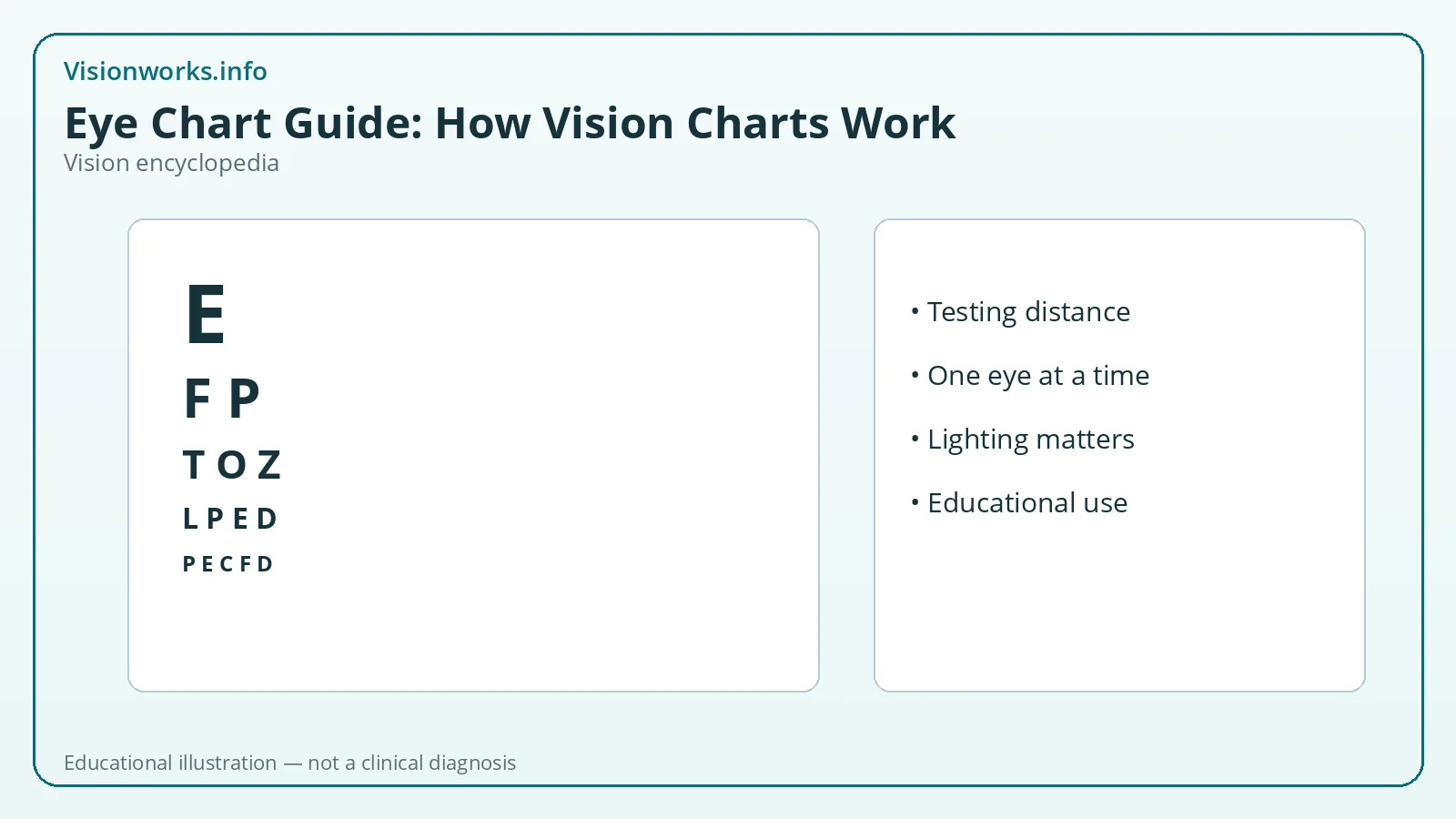
What an eye chart is for
An eye chart is a tool for estimating visual acuity — the ability to resolve detail — under specified conditions. It does not measure eye pressure, scan the retina, or determine a full glasses prescription by itself.
In clinics, charts are paired with known viewing distances, controlled lighting, and occlusion of one eye at a time. Those controls are why a hallway poster and a phoropter room are not interchangeable experiences.
People recognize the big “E” culturally, but modern clinics may use letters, numbers, Landolt C, tumbling E, or pediatric symbols depending on age and language needs.
Distance, angular size, and fairness
Acuity is fundamentally about angular size: how large the detail appears to the eye. A letter that is physically large but viewed from far away can subtend the same angle as a tiny letter viewed up close. Clinical scoring assumes the correct pairing of size and distance.
If you stand too close to a chart designed for 20 feet, you may read smaller lines than your distance acuity supports. If you stand too far, you may underperform. Zooming a browser window creates the same class of error digitally.
That geometry is also why educational on-screen tools must warn about calibration. CSS pixels are not automatically arcminutes of visual angle.
How clinicians score responses
Protocols define how many letters you must identify correctly to “get” a line, whether credit is given for partially correct lines, and whether habitual or best correction is worn. Crowding (letters packed closely) can make charts harder than widely spaced letters of the same size.
Contrast matters. High-contrast black-on-white acuity can look better than real-world low-contrast tasks like night driving in rain. Acuity is one slice of visual performance.
AAO and MedlinePlus exam overviews place chart testing early in the visit, then move on to refraction and health checks that the chart cannot replace.
Home charts and school screenings
School screenings use charts or instruments to flag children who need full exams. A pass is not a comprehensive health clearance; a fail should prompt a professional exam rather than repeated DIY retesting alone.
Home charts can teach family members what acuity notation means. They become harmful when used to self-prescribe lenses or to postpone care after a clear drop in one eye’s vision.
For hands-on learning, try the Visionworks.info educational visual acuity tool, then read our limitations article before interpreting any result.
Related concepts to learn next
Dive deeper into Snellen’s history and notation, compare 20/20 with other levels in our acuity library, and learn how refraction turns blur into a lens prescription. Charts start the conversation; clinicians finish it.
If your goal is understanding prescription paperwork rather than chart lines, see how to read a glasses prescription and the prescription decoder tool.
Deeper context for careful readers
This page (/vision/eye-chart) is written for education, not diagnosis. The goal is to help you ask better questions at a real appointment and to understand vocabulary you may see on charts, portals, or prescription printouts.
Authoritative organizations such as the AOA, AAO, NEI, and MedlinePlus publish consumer-facing explanations that clinicians still individualize. If anything you read here conflicts with advice from your eye doctor, follow your clinician — they can see your eyes and history; a website cannot.
Between visits, note changes by eye, by distance (far versus near), and by timing (constant versus end of day). Those details make exams more efficient without turning self-tracking into self-diagnosis.
Urgent warning signs still override any routine schedule: sudden vision loss, a curtain or shadow, painful red eye with nausea, chemical exposure, or trauma require prompt in-person care.
Visionworks.info tools can reinforce concepts — acuity notation, prescription fields, symptom vocabulary — while remaining explicitly non-diagnostic. Use them as study aids alongside professional care, not as replacements for refraction, dilation, or medical treatment decisions.
When you compare information across websites, prefer primary sources from AOA, AAO, NEI, MedlinePlus, CDC, FTC, or FDA pages that match your topic. Marketing blogs and unverified social videos often oversimplify intervals, prescriptions, or “pass/fail” chart claims.
Finally, keep expectations proportionate: understanding a term should make your next visit clearer, not turn you into your own optometrist. Curiosity is useful; unsupervised lens ordering from guessed numbers is not.
When professional care matters
Schedule an eye exam if you notice new blur, eye discomfort that persists, headaches tied to visual tasks, difficulty with night driving, or any sudden change in vision. Children, people with diabetes, and anyone with a history of eye disease often need scheduled professional monitoring rather than relying on online tools alone.
Seek urgent or emergency care for sudden vision loss, a curtain or shadow over vision, new flashes with many floaters, severe eye pain, chemical exposure, or eye trauma.