
Snellen in plain language
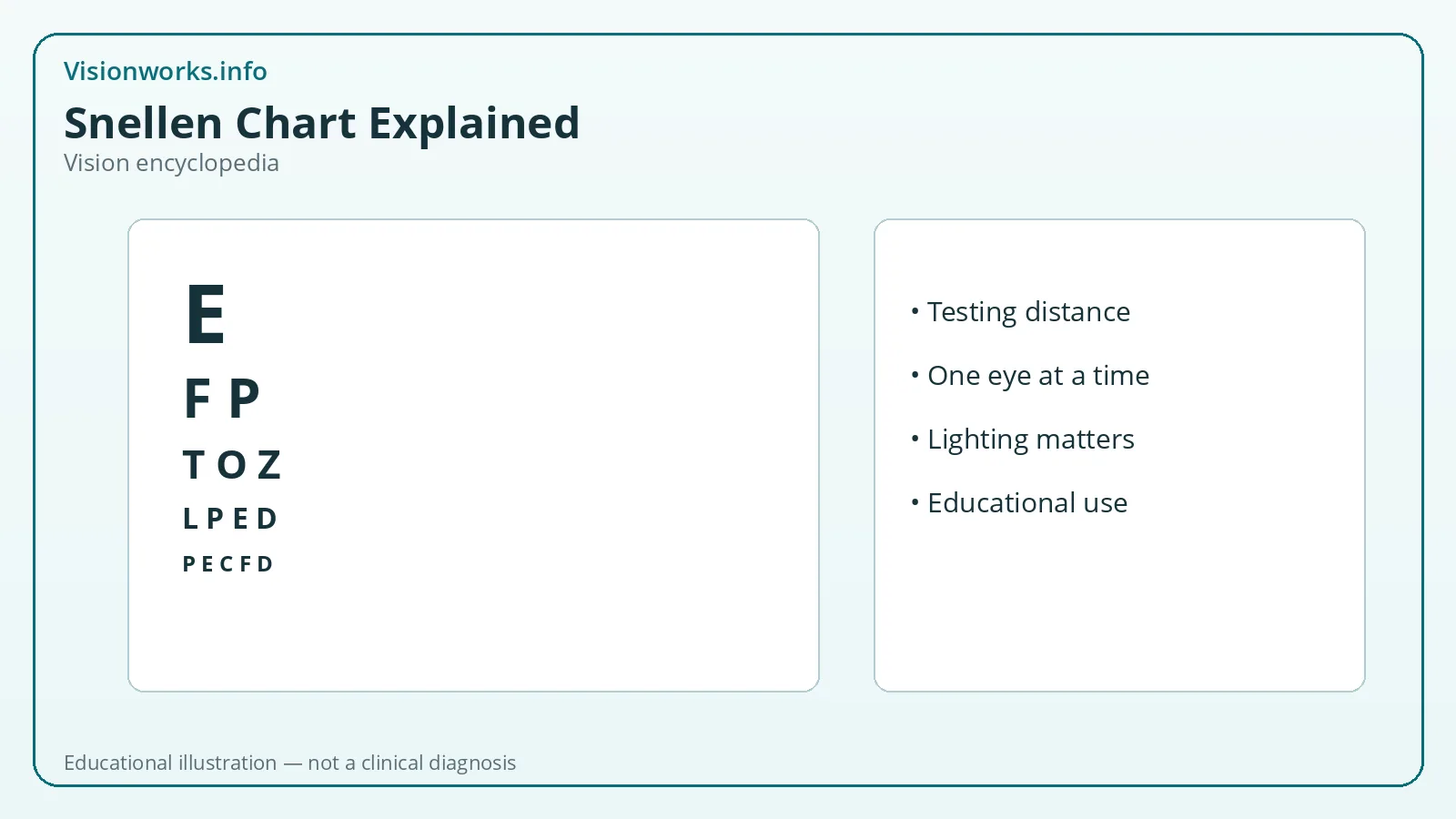
A Snellen chart presents rows of letters that get smaller toward the bottom. Each row corresponds to an acuity level such as 20/40 or 20/20 when viewed from the chart’s designed distance. The large top letters are readable with much lower detail resolution.
The fraction’s first number is the test distance (often 20 feet in U.S. customary usage). The second number is the distance at which a person with reference “normal” acuity would identify letters of that size. Larger denominators mean coarser detail was needed.
NEI explanations of how eyes focus and MedlinePlus vision-impairment materials provide helpful context for why clarity measurements matter in care and public health — without equating one fraction to overall eye wellness.
Design quirks and modern alternatives
Classic Snellen layouts do not always have the same number of letters on every line, and letter spacing may not meet newer research standards. That does not make clinic Snellen useless; it means comparisons across chart types need care.
ETDRS-style charts standardize five letters per line and use logarithmic size steps, which improves statistical comparison in studies. Some clinics use electronic charts that can randomize letters to reduce memorization.
Pediatric and low-literacy settings may avoid letter charts entirely. The concept — calibrated detail size at a known distance — remains the same.
Reading a Snellen result
If your record says 20/20 OD and 20/25 OS, each eye was tested separately (OD right, OS left). Binocular acuity may also be recorded. Best-corrected versus uncorrected should be labeled; mixing them causes confusion when shopping for glasses online.
A change from 20/20 to 20/40 is meaningful and deserves clinical interpretation. It might be uncorrected refractive error, ocular surface blur, cataract progression, or another cause. The chart documents the change; it does not name the cause.
Use our Snellen converter to explore decimal and logMAR equivalents educationally. Conversion math does not replace the exam that produced the measurement.
Memorization and fairness
People who memorize the classic chart order can artificially inflate scores. Clinicians may use alternate versions or digital randomization. Home posters hung in living rooms are especially vulnerable to memorization by kids who see them daily.
Covering the other eye completely matters. Peeking is common in children and invalidates comparisons. Occluders exist for a reason.
Ambient glare on glossy charts or phone reflections can also reduce contrast. Fair testing controls the environment.
Where Snellen fits in your learning path
Learn the notation, then learn its limits. Our eye-chart limitations article explains why screenshot charts fail calibration. Our 20/20 explorer shows relative letter sizes. Eye exam pages explain how acuity testing sits beside refraction and dilation.
If you only remember one idea: Snellen fractions communicate detail resolution under test conditions. They are not a brand score for your worth, and they are not a full health clearance.
Deeper context for careful readers
This page (/vision/snellen-chart) is written for education, not diagnosis. The goal is to help you ask better questions at a real appointment and to understand vocabulary you may see on charts, portals, or prescription printouts.
Authoritative organizations such as the AOA, AAO, NEI, and MedlinePlus publish consumer-facing explanations that clinicians still individualize. If anything you read here conflicts with advice from your eye doctor, follow your clinician — they can see your eyes and history; a website cannot.
Between visits, note changes by eye, by distance (far versus near), and by timing (constant versus end of day). Those details make exams more efficient without turning self-tracking into self-diagnosis.
Urgent warning signs still override any routine schedule: sudden vision loss, a curtain or shadow, painful red eye with nausea, chemical exposure, or trauma require prompt in-person care.
Visionworks.info tools can reinforce concepts — acuity notation, prescription fields, symptom vocabulary — while remaining explicitly non-diagnostic. Use them as study aids alongside professional care, not as replacements for refraction, dilation, or medical treatment decisions.
When you compare information across websites, prefer primary sources from AOA, AAO, NEI, MedlinePlus, CDC, FTC, or FDA pages that match your topic. Marketing blogs and unverified social videos often oversimplify intervals, prescriptions, or “pass/fail” chart claims.
Finally, keep expectations proportionate: understanding a term should make your next visit clearer, not turn you into your own optometrist. Curiosity is useful; unsupervised lens ordering from guessed numbers is not.
When professional care matters
Schedule an eye exam if you notice new blur, eye discomfort that persists, headaches tied to visual tasks, difficulty with night driving, or any sudden change in vision. Children, people with diabetes, and anyone with a history of eye disease often need scheduled professional monitoring rather than relying on online tools alone.
Seek urgent or emergency care for sudden vision loss, a curtain or shadow over vision, new flashes with many floaters, severe eye pain, chemical exposure, or eye trauma.