
Three roles people mix up
In U.S. consumer language, “eye doctor” can mean either an optometrist or an ophthalmologist. A third professional — the optician — is essential for eyewear but is not a medical examiner. Understanding the trio prevents mismatched expectations.
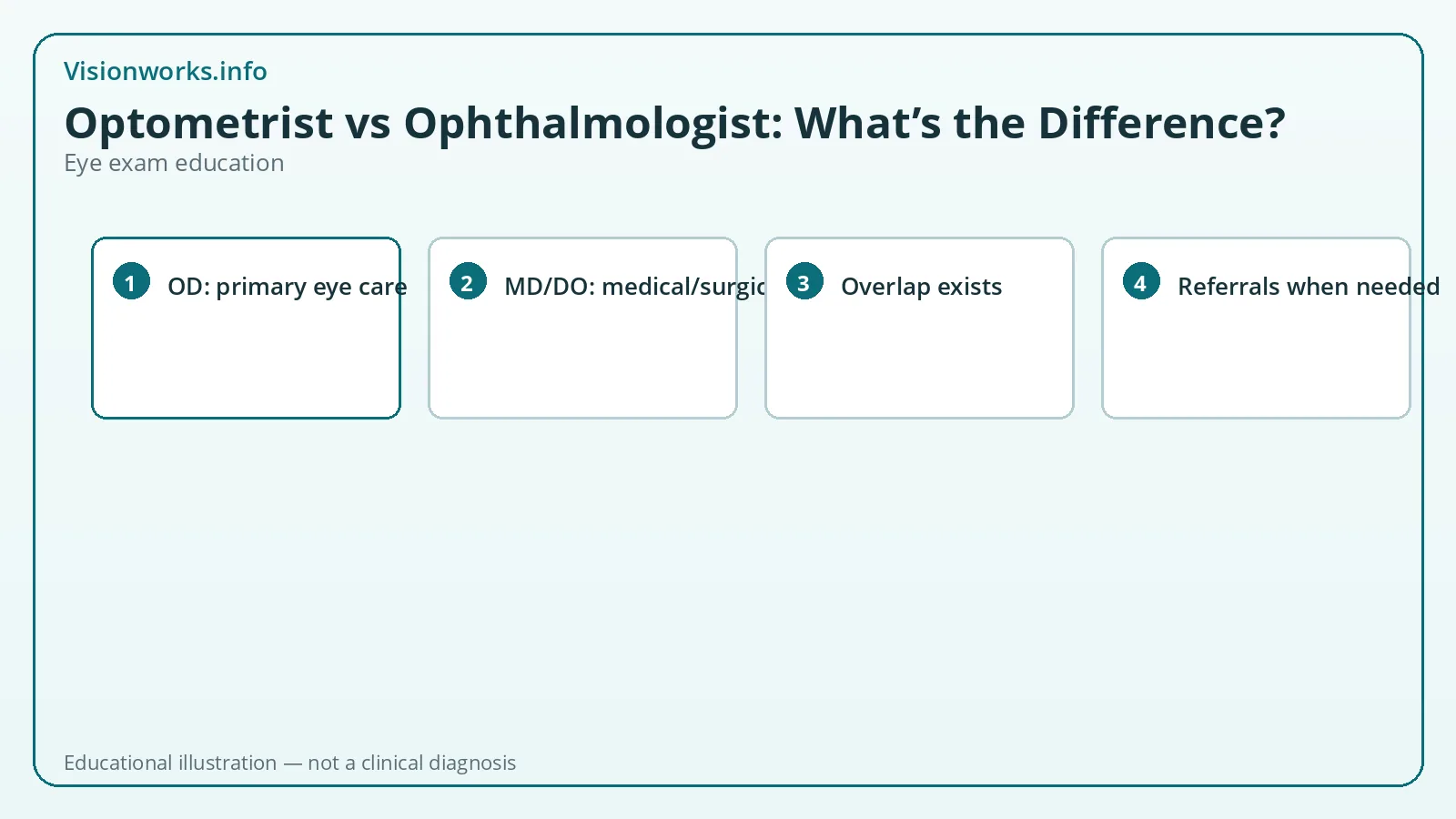
AAO education on ophthalmologists versus optometrists explains that ophthalmologists are medical or osteopathic physicians (MD/DO) specializing in eye and vision care, including surgery, while optometrists hold Doctor of Optometry (OD) degrees and provide primary vision care including exams, corrective lenses, and management of certain eye conditions depending on state licensure.
Scope details vary by state. This article is general education, not a state-by-state practice-law manual.
Optometrists (OD)
Optometrists complete optometry school after undergraduate education and are licensed to examine eyes, prescribe glasses and contacts, and detect and manage many eye conditions as allowed by state law. They are often the first stop for routine comprehensive exams, contact lens care, binocular vision concerns, and common anterior segment problems.
Many optometrists work alongside ophthalmologists in the same practices, co-managing patients. That teamwork model is common and can improve access while routing surgical cases appropriately.
If your needs are routine refractive care, dry eye management within scope, or diabetes monitoring in a primary eye-care setting, an optometrist is frequently an appropriate entry point — with referral when findings exceed scope or require surgery.
Ophthalmologists (MD/DO)
Ophthalmologists complete medical school and ophthalmology residency. They diagnose and treat the full spectrum of eye disease, prescribe glasses and contacts, and perform surgery — from cataract extraction to retinal and glaucoma procedures depending on subspecialty training.
Because they are physicians, they also train to recognize ocular signs of systemic disease and coordinate with other medical specialists. Subspecialists focus more narrowly (retina, cornea, glaucoma, pediatrics, oculoplastics, neuro-ophthalmology, and others).
You might see an ophthalmologist first for known surgical pathology, sudden severe disease, or when another physician refers you. You might also be referred after an optometric exam finds something needing medical/surgical expertise.
Opticians
Opticians use prescriptions written by optometrists or ophthalmologists to help select, fit, and dispense eyewear. Measurements such as optical centers and fitting heights for progressives are part of quality dispensing. They are crucial for comfort and optics — but a frame selection appointment is not a dilated retinal exam.
If an optical shop offers “eye exams,” ask who performs them and what credentials they hold. Titles on a storefront can be ambiguous; the clinician’s license type should be clear.
Choosing based on your goal
Goal: routine exam and glasses/contacts → often optometry. Goal: cataract surgery evaluation → ophthalmology (often after screening elsewhere). Goal: red eye while traveling → either may help depending on severity; urgent symptoms need urgent settings.
For children with complex strabismus or adults with retinal detachment symptoms, specialty ophthalmology pathways are common. For progressive lenses and annual diabetic eye checks, many patients are well served in optometric primary care with referral networks.
Wherever you go, a comprehensive evaluation should address both vision correction and eye health appropriate to your risk. Credentials matter; marketing slogans do not replace training.
Deeper context for careful readers
This page (/eye-exams/optometrist-vs-ophthalmologist) is written for education, not diagnosis. The goal is to help you ask better questions at a real appointment and to understand vocabulary you may see on charts, portals, or prescription printouts.
Authoritative organizations such as the AOA, AAO, NEI, and MedlinePlus publish consumer-facing explanations that clinicians still individualize. If anything you read here conflicts with advice from your eye doctor, follow your clinician — they can see your eyes and history; a website cannot.
Between visits, note changes by eye, by distance (far versus near), and by timing (constant versus end of day). Those details make exams more efficient without turning self-tracking into self-diagnosis.
Urgent warning signs still override any routine schedule: sudden vision loss, a curtain or shadow, painful red eye with nausea, chemical exposure, or trauma require prompt in-person care.
Visionworks.info tools can reinforce concepts — acuity notation, prescription fields, symptom vocabulary — while remaining explicitly non-diagnostic. Use them as study aids alongside professional care, not as replacements for refraction, dilation, or medical treatment decisions.
When you compare information across websites, prefer primary sources from AOA, AAO, NEI, MedlinePlus, CDC, FTC, or FDA pages that match your topic. Marketing blogs and unverified social videos often oversimplify intervals, prescriptions, or “pass/fail” chart claims.
Finally, keep expectations proportionate: understanding a term should make your next visit clearer, not turn you into your own optometrist. Curiosity is useful; unsupervised lens ordering from guessed numbers is not.
When professional care matters
Schedule an eye exam if you notice new blur, eye discomfort that persists, headaches tied to visual tasks, difficulty with night driving, or any sudden change in vision. Children, people with diabetes, and anyone with a history of eye disease often need scheduled professional monitoring rather than relying on online tools alone.
Seek urgent or emergency care for sudden vision loss, a curtain or shadow over vision, new flashes with many floaters, severe eye pain, chemical exposure, or eye trauma.