
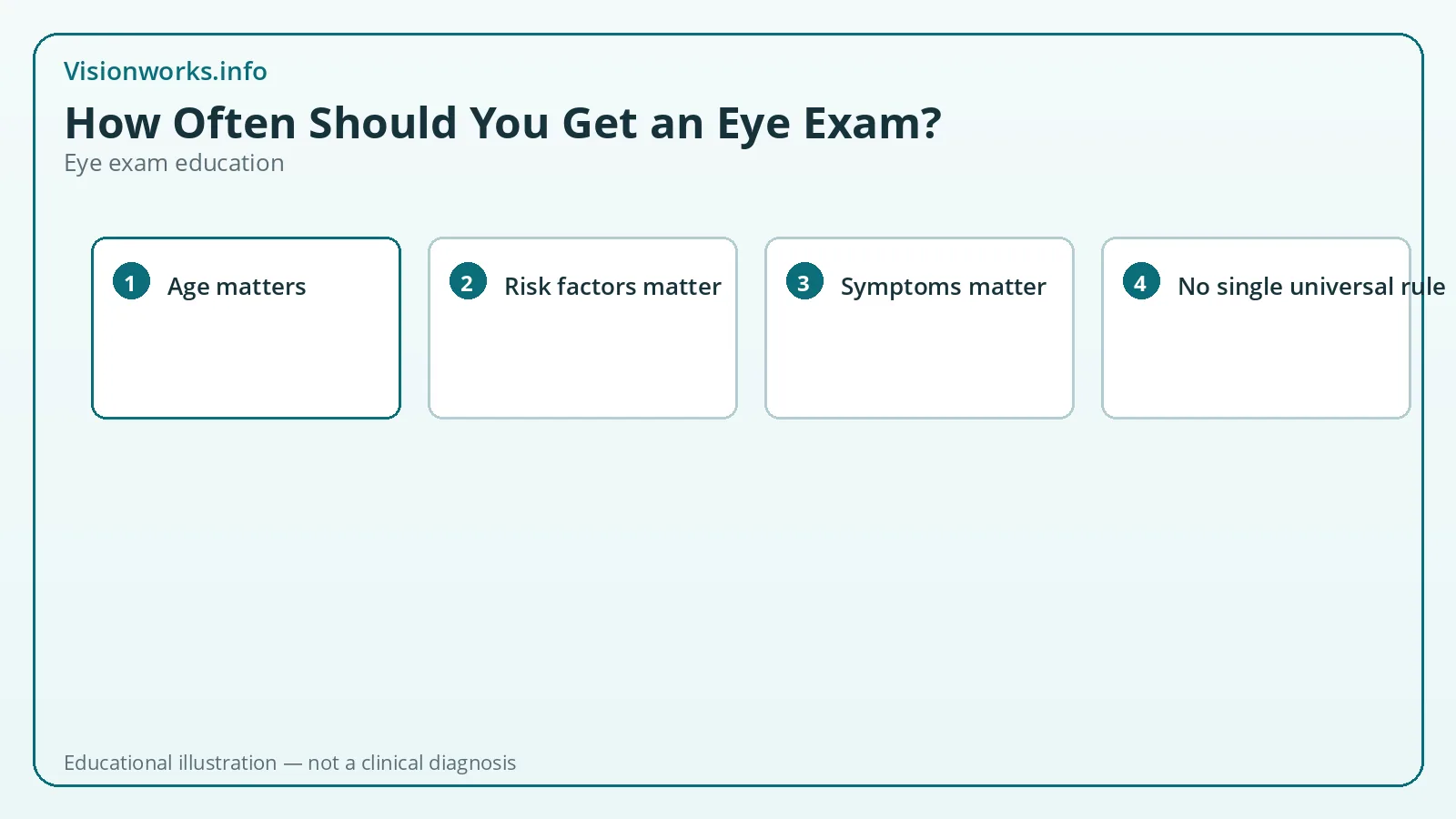
No single universal rule
Search results sometimes claim “everyone needs an eye exam every year” or “every two years” as if one slogan covered all ages and risks. Real guidance is more nuanced. Professional organizations publish age-banded and risk-banded recommendations, and your personal clinician may shorten or lengthen intervals based on findings.
AOA comprehensive exam resources discuss recommended intervals that differ across adulthood — for example, guidance themes that asymptomatic lower-risk adults in certain age bands may be seen less often than adults 65+, while higher-risk patients need closer follow-up. Those statements are starting frameworks, not a substitute for individualized advice.
AAO patient education also stresses the importance of complete exams and age-related screening conversations (such as getting evaluated for eye disease risk around midlife). NEI healthy-vision guidance similarly encourages exams as part of protecting sight, especially when risk rises.
Age-related themes (educational, not a personal schedule)
Childhood and school years: vision problems can affect learning, and some conditions are time-sensitive. Pediatric intervals differ from adult routines; follow pediatric eye-care recommendations from your child’s clinician.
Early and middle adulthood: many low-risk asymptomatic adults are not on the same annual cadence as older adults, but symptoms, contact lenses, high prescriptions, or systemic disease can move you into more frequent care. Presbyopia often appears in the 40s, increasing near-vision visits and optical updates.
Older adults: cataracts, glaucoma risk, macular disease, and systemic comorbidity become more common. Annual or otherwise closer comprehensive monitoring is a frequent counseling theme for older age bands — again personalized by the clinician.
Risk factors that usually shorten intervals
- Diabetes or other systemic diseases with ocular effects
- Family history of glaucoma or other inherited eye disease
- Prior retinal tears, detachments, or ocular surgery
- High myopia or other structural risk profiles
- Current contact lens wear, especially extended wear or specialty lenses
- Medications with known ocular side effects
- New or changing visual symptoms
If any of these apply, do not rely on a generic blog interval. Ask your eye clinician what follow-up they recommend and why. Bring records when you change clinics so intervals are not reset blindly.
Symptoms override the calendar
Schedules assume relative stability. Sudden vision loss, a shadow/curtain, new flashes with many floaters, severe pain, chemical exposure, or trauma are urgent pathways — not “wait until my annual month.”
Gradual changes matter too: difficulty with night glare, needing brighter light to read, headaches with near work, or one eye drifting out of focus. Book sooner rather than stretching a distant recall date.
Visionworks.info symptom guides can help you organize descriptions for the appointment. They are educational and not triage bots.
Practical takeaway
Use professional recommendations as a conversation starter, then follow the plan documented in your exam record. If you cannot remember when you were last dilated or whether imaging substituted for dilation, ask at your next visit.
Insurance coverage intervals and clinical need are not always identical. Coverage rules may affect cost timing; clinical risk should still guide when you seek care.
Between exams, protect eye health with UV-aware habits, contact lens hygiene if applicable, and prompt attention to sudden changes — while remembering that habits do not replace examinations.
Deeper context for careful readers
This page (/eye-exams/how-often-should-you-get-an-eye-exam) is written for education, not diagnosis. The goal is to help you ask better questions at a real appointment and to understand vocabulary you may see on charts, portals, or prescription printouts.
Authoritative organizations such as the AOA, AAO, NEI, and MedlinePlus publish consumer-facing explanations that clinicians still individualize. If anything you read here conflicts with advice from your eye doctor, follow your clinician — they can see your eyes and history; a website cannot.
Between visits, note changes by eye, by distance (far versus near), and by timing (constant versus end of day). Those details make exams more efficient without turning self-tracking into self-diagnosis.
Urgent warning signs still override any routine schedule: sudden vision loss, a curtain or shadow, painful red eye with nausea, chemical exposure, or trauma require prompt in-person care.
Visionworks.info tools can reinforce concepts — acuity notation, prescription fields, symptom vocabulary — while remaining explicitly non-diagnostic. Use them as study aids alongside professional care, not as replacements for refraction, dilation, or medical treatment decisions.
When you compare information across websites, prefer primary sources from AOA, AAO, NEI, MedlinePlus, CDC, FTC, or FDA pages that match your topic. Marketing blogs and unverified social videos often oversimplify intervals, prescriptions, or “pass/fail” chart claims.
Finally, keep expectations proportionate: understanding a term should make your next visit clearer, not turn you into your own optometrist. Curiosity is useful; unsupervised lens ordering from guessed numbers is not.
When professional care matters
Schedule an eye exam if you notice new blur, eye discomfort that persists, headaches tied to visual tasks, difficulty with night driving, or any sudden change in vision. Children, people with diabetes, and anyone with a history of eye disease often need scheduled professional monitoring rather than relying on online tools alone.
Seek urgent or emergency care for sudden vision loss, a curtain or shadow over vision, new flashes with many floaters, severe eye pain, chemical exposure, or eye trauma.