
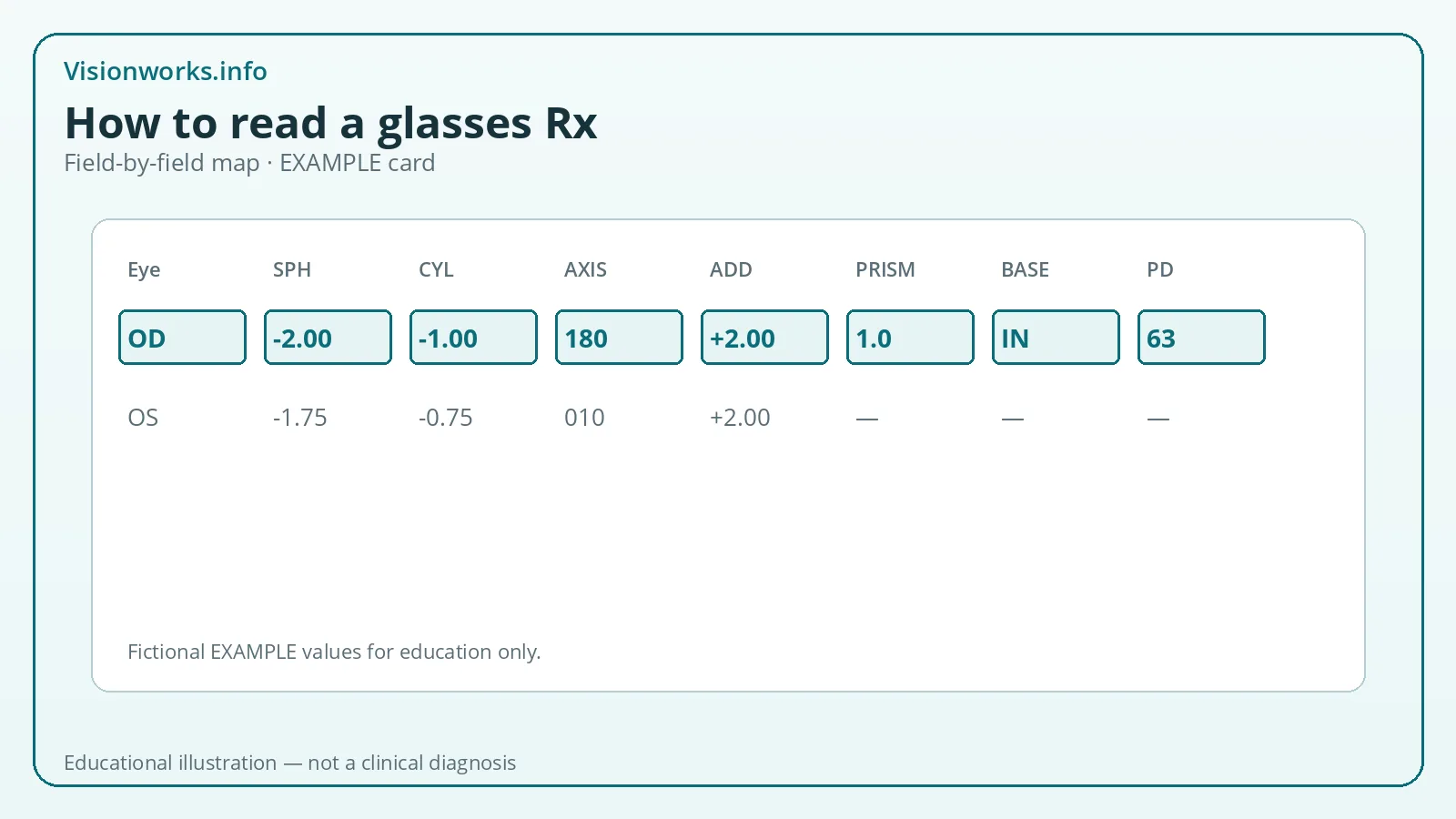
Start with the eyes: OD, OS, OU
Most U.S. glasses prescriptions list each eye separately. OD is the right eye, OS is the left, and OU means both eyes when a value applies binocularly. Clinics may also print “RE/LE” instead of Latin abbreviations.
Never swap eyes when ordering. A right/left mix-up is a common do-it-yourself error when retyping numbers into online forms. Copy carefully or upload a clear scan when permitted.
If one eye is “BAL” or has unusual notation, ask the prescribing office before guessing. Special notations exist for balance lenses and other edge cases.
SPH (sphere): nearsighted and farsighted power
Sphere is the primary nearsighting or farsighting correction in diopters. Minus values are typically associated with myopia; plus values with hyperopia or certain near corrections depending on context. Plano or 0.00 means no spherical power.
Sphere alone does not describe astigmatism. Two people with the same sphere can need very different cylinders. See our sphere encyclopedia pages for example values and careful interpretation.
NEI refractive-error education is a solid external primer if you want authoritative background on myopia, hyperopia, and astigmatism definitions.
CYL and AXIS: astigmatism notation
Cylinder (CYL) is the additional power for astigmatism. Axis, from 1 to 180 degrees, orients that cylinder. If CYL is empty or zero, axis is generally not used.
Prescriptions may appear in minus-cylinder or plus-cylinder form. They can represent the same optical correction when transposed correctly — a clinicial/optical skill, not a casual arithmetic hobby. Our transposition education page explains the concept carefully.
Do not “fix” missing axis values by inventing 90 or 180. Incomplete astigmatism data produces wrong lenses.
ADD, prism, and multifocal needs
ADD is additional near power for bifocals, progressives, or certain workplace lenses, commonly related to presbyopia. It is usually the same for both eyes but not always. Computer-specific intermediate prescriptions may differ from standard reading ADDs.
Prism and base direction correct binocular alignment needs when prescribed. Prism is not decorative; incorrect prism can cause discomfort or double vision. If you see prism values, ensure the dispenser receives them exactly.
AAO glasses education helps frame how different lens designs serve distance, near, and combined needs after a clinician decides what is appropriate.
PD, expiration, and your rights education
Pupillary distance (PD) supports proper optical center placement. Some Rx forms include it; otherwise opticians measure it. Dual PD (right and left) is often preferred for progressives and higher powers.
Prescriptions expire. Expiration encourages updated eye-health evaluation and current refractive data. Sellers may legally and professionally refuse expired Rxs.
In the United States, FTC Eyeglass Rule materials discuss release of eyeglass prescriptions after refractive exams. Read the FTC source and our educational rights page — neither is personalized legal advice. Use the prescription decoder tool to practice reading fields you already have from a valid Rx.
Deeper context for careful readers
This page (/prescription/how-to-read-glasses-prescription) is written for education, not diagnosis. The goal is to help you ask better questions at a real appointment and to understand vocabulary you may see on charts, portals, or prescription printouts.
Authoritative organizations such as the AOA, AAO, NEI, and MedlinePlus publish consumer-facing explanations that clinicians still individualize. If anything you read here conflicts with advice from your eye doctor, follow your clinician — they can see your eyes and history; a website cannot.
Between visits, note changes by eye, by distance (far versus near), and by timing (constant versus end of day). Those details make exams more efficient without turning self-tracking into self-diagnosis.
Urgent warning signs still override any routine schedule: sudden vision loss, a curtain or shadow, painful red eye with nausea, chemical exposure, or trauma require prompt in-person care.
Visionworks.info tools can reinforce concepts — acuity notation, prescription fields, symptom vocabulary — while remaining explicitly non-diagnostic. Use them as study aids alongside professional care, not as replacements for refraction, dilation, or medical treatment decisions.
When you compare information across websites, prefer primary sources from AOA, AAO, NEI, MedlinePlus, CDC, FTC, or FDA pages that match your topic. Marketing blogs and unverified social videos often oversimplify intervals, prescriptions, or “pass/fail” chart claims.
Finally, keep expectations proportionate: understanding a term should make your next visit clearer, not turn you into your own optometrist. Curiosity is useful; unsupervised lens ordering from guessed numbers is not.
When professional care matters
Schedule an eye exam if you notice new blur, eye discomfort that persists, headaches tied to visual tasks, difficulty with night driving, or any sudden change in vision. Children, people with diabetes, and anyone with a history of eye disease often need scheduled professional monitoring rather than relying on online tools alone.
Seek urgent or emergency care for sudden vision loss, a curtain or shadow over vision, new flashes with many floaters, severe eye pain, chemical exposure, or eye trauma.